Divestment/Disinvestment Policies and Documents & Sustainable and Responsible Investment Policies and Documents
The University of Johannesburg (UJ) has demonstrated a commitment to environmental sustainability through various initiatives, such as the implementation of on-campus solar power projects and the introduction of electric buses to reduce carbon emissions. UJ does not have a formal divestment policy specifically aimed at withdrawing investments from carbon-intensive energy industries, notably coal and oil, however these concepts are broadly embedded in its investment policies that incorporate ESG (Environmental, Social, and Governance) considerations. Investment Policies and Sustainability Considerations UJ's investment strategies are primarily outlined in its Finance and Investment Policy and the Investment Strategy Statement of the University of Johannesburg Pension Fund. The Finance and Investment Policy, last reviewed in March 2023, provides a framework for the university's financial management and investment decisions. While it addresses various aspects of financial governance, it does not explicitly mention divestment from fossil fuels. The Investment Strategy Statement of the UJ Pension Fund, reviewed in 2022, articulates the fund's approach to responsible investing. It acknowledges that environmental, social, and governance (ESG) factors can influence investment performance and states that the fund interrogates asset managers about their active ownership approaches, including engagement and proxy voting records, as well as their ESG policies. Asset managers are required to exercise active ownership responsibilities to positively influence underlying companies in areas such as sustainability. However, the statement does not specify a mandate to divest from fossil fuel industries. Sustainability Initiatives Despite the absence of a formal divestment policy, UJ has undertaken significant sustainability initiatives:- On-Campus Solar Power Initiative: Since 2020, UJ has installed over 4,450 solar panels on campus rooftops and carports, managing over 1,700 kilowatts of solar photovoltaic power. This initiative demonstrates UJ's commitment to reducing reliance on the national power grid and lowering carbon emissions.
- Electric Bus Fleet: In early 2023, UJ introduced electric buses to its inter-campus transport fleet, becoming the first South African university to do so. This move aims to reduce carbon emissions associated with transportation and showcases UJ's proactive approach to sustainable practices.
UJ Investment Policy / Strategy Statement
UJ Investment Policy Statement 2022
Year policy created: 2012Year policy reviewed: 2022Year policy next review: 2025UJ Investment Strategy Statement 2022
Year policy created: 2022Year policy reviewed: 2022Year policy next review: 2023UJ Investment Strategy Statement 2021
UJ Investment Strategy Statement 2020
Refer to the UJ Investment Strategy Statement in the UJ Pension Fund Annual Trustee Report for 2022:Investment Strategy Statement
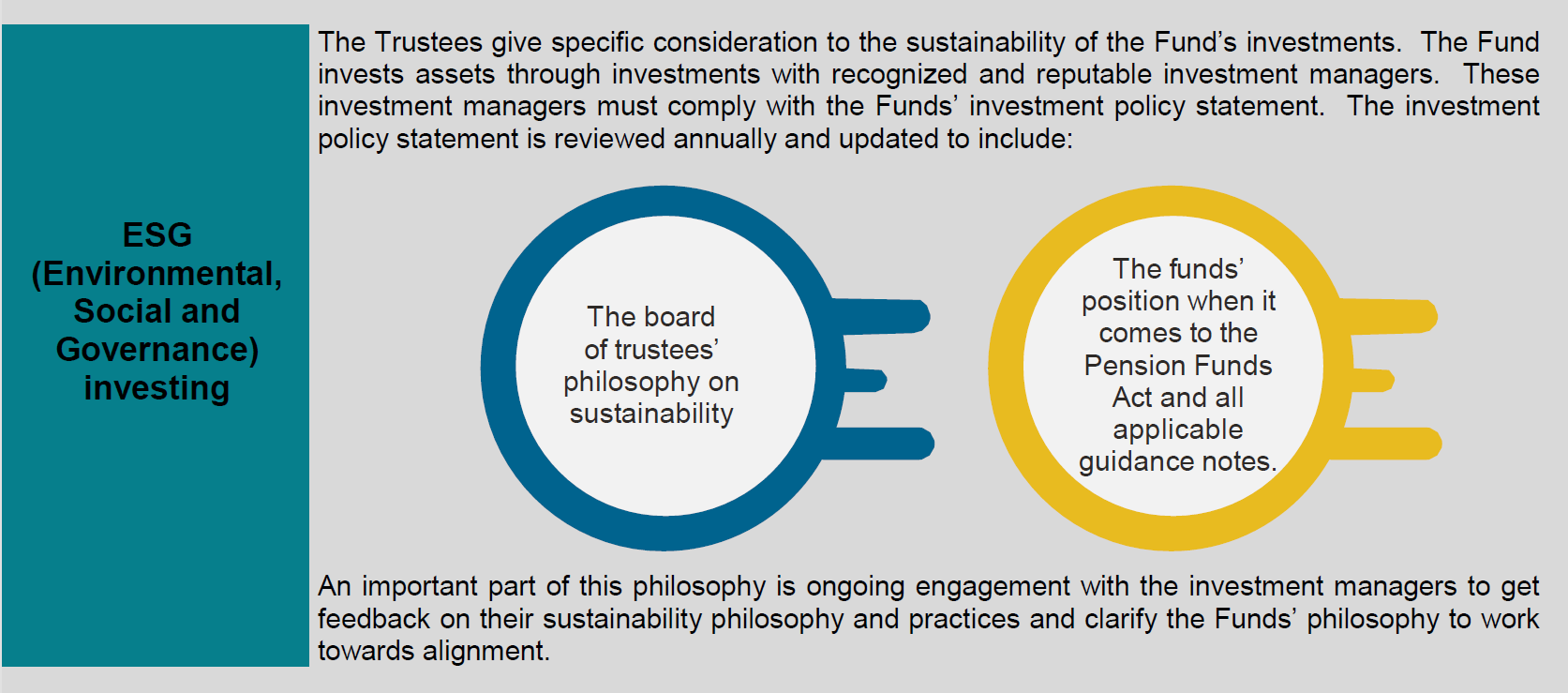
"This statement is intended to explain and summarise the investment strategy of the University of Johannesburg Pension Fund (the fund) to members. The complete investment strategy document is available on the Fund intranet at: https://universityofjohannesburg.us/4ir/uj-pension/ The fund is a defined contribution pension fund. Members participate directly in the investment performance of the fund’s investments and retirement outcomes are not guaranteed. The fund informs members of the level of retirement income they could reasonably expect to purchase at retirement, given their existing retirement savings in the fund, their current contribution to the fund and expected future investment returns. Various assumptions are made to project retirement outcomes and these outcomes are not guaranteed. The fund uses a goals-based life-stage investment model where members’ retirement savings are gradually moved from the fund’s growth portfolio to the pre-retirement portfolio from five years before normal retirement age. The fund uses the growth portfolio to try to achieve a long-term real return of CPI + 6% per annum. To stand a good chance of achieving this return, the portfolio has a relatively large exposure to share markets and the investment risks associated with these markets. This is the default investment portfolio for younger members. As members get closer to retirement, the default strategy is for retirement fund assets to be invested more conservatively to reduce the risk of capital loss. Members can opt out of the life-stage model and can then select portfolios from the investment choices available to members of the fund. Members can ask their HR representative for the member investment choice booklet if they are interested in this option. The fund participates in pooled investment portfolios together with other retirement funds. These investment portfolios are provided and managed by the fund’s appointed asset managers. The trustees frequently monitor the performance of the fund’s investment portfolios and, should the trustees believe it to be appropriate to do so, the trustees will replace the manager or investment portfolios with more suitable manager(s) or investment portfolios. The Trustees believe that material extra-financial factors relating to environmental, social and governance (ESG) issues can affect the performance of investment portfolios. Responsible investing is an approach that incorporates these material extra-financial factors into investment processes and activities with the objective of decreasing investment risk and improving risk-adjusted returns. Active ownership requires the fulfilment of ownership duties in order to give effect to the above responsible investment approach. The responsibility for the management of the fund’s assets has been delegated to the asset managers appointed by the fund and these managers will be interrogated about their active ownership approach including, engagement and proxy voting record, as well as their ESG policies. Asset managers are required to exercise active ownership responsibilities on behalf of the fund to positively influence the underlying companies in areas such as sustainability through proxy voting and other engagement. The Trustees recognise the increasing importance of ESG factors in social society, and the important role that pension funds have in ensuring responsible corporate behaviour. The Trustees have decided not to invest any of the fund’s assets in specific Socially Responsible Investing/ESG products or investments, but will monitor on an annual basis, what the investment managers are doing in this regard. The Trustees have taken account of the principles contained in the Code for Responsible Investing in South Africa. The fund has also made certain retirement product options available to members in line with default regulations. More details are available in the fund’s relevant ‘options on retirement’ and ‘options on leaving’ fund booklets. The trustees will review the fund’s investment strategy at least every year to ensure that it remains appropriate for the fund and its members."